
Engineering Question
How Does a Chilled Water System Work?
Chilled water absorbs heat at building coils, returns to the chiller, rejects that heat at a cooling tower or air-cooled condenser, and is pumped back out as cold supply water.

Reviewed by
Michael K. Frempong, PE, LEED AP
President & Principal Engineer, BEED Engineering
Michael K. Frempong is a professional engineer and LEED AP accredited professional with over 20 years of experience in consulting engineering. As President & Principal Engineer at BEED Engineering, he leads the firm’s MEP design and consulting work for laboratory, healthcare, industrial, data center, education, commercial, municipal, and other building projects throughout Florida.
View BEED team profileQuick Answer
A chilled water system works in a loop. Pumps send cold water to cooling coils, where the water absorbs heat from building air. The warmer water returns to the chiller, which removes that heat and sends cold water back out. The chiller then rejects the collected heat through a cooling tower or air-cooled condensers. Controls stage equipment so the plant matches the building load.
On this page
The loop in plain language
Start with what a chilled water system is. Operation is a repeating cycle:
- The chiller produces cold supply water.
- Pumps send that water to air-handling unit coils.
- Warm building air passes over the coils. The water absorbs heat and the air is cooled and dehumidified.
- Warmer water returns to the chiller.
- The chiller transfers that heat to condenser water or to air-cooled condensers.
- A cooling tower, if used, rejects heat to the outdoor air.
Two water circuits
Most water-cooled plants have two hydronic circuits:
- Chilled water: building side. Cold supply, warmer return.
- Condenser water: heat-rejection side. Warm water from the chiller to the tower, cooler water back.
Air-cooled chillers skip the tower and reject heat directly to outdoor air. They can simplify water treatment but have different efficiency and sound characteristics.
What the controls do
Building automation typically:
- Starts pumps before chillers
- Stages chillers with load
- Resets water temperature when conditions allow
- Protects against low flow and freeze conditions
- Coordinates air-handler valves and plant capacity
Without a defined sequence of operations, a plant can run inefficiently even if the chiller itself is new.
That sequence work is part of how BEED has approached campus plants such as Meadowlane Intermediate School and Lake Nona Middle School, where one chilled-water plant serves mixed occupancies.
Where systems fail in the field
- Dirty coils and incorrect water flow
- Control valves that do not close
- Pumps operating against closed paths
- Tower issues in coastal or high-humidity climates
- Mismatched coil entering-water temperatures
When to involve an engineer
Involve an engineer when adding load to an existing loop, replacing a chiller, converting constant-flow to variable-flow pumping, or investigating comfort and energy complaints. Those problems are design problems, not only maintenance problems.
Related BEED projects
All projects →Selected work that shows how BEED has applied this kind of engineering on real buildings.
BEED Engineering
Education
Oviedo High School
Oviedo, Florida · Mechanical + Plumbing Engineering
Education
Oviedo High School
Campus Renovations
Oviedo, Florida
400,000 SF
Mechanical + Plumbing Engineering
Mechanical and plumbing engineering and project administration for 400,000 square feet of high school renovations in Oviedo, Florida, including a water-cooled central chiller plant.
View Project →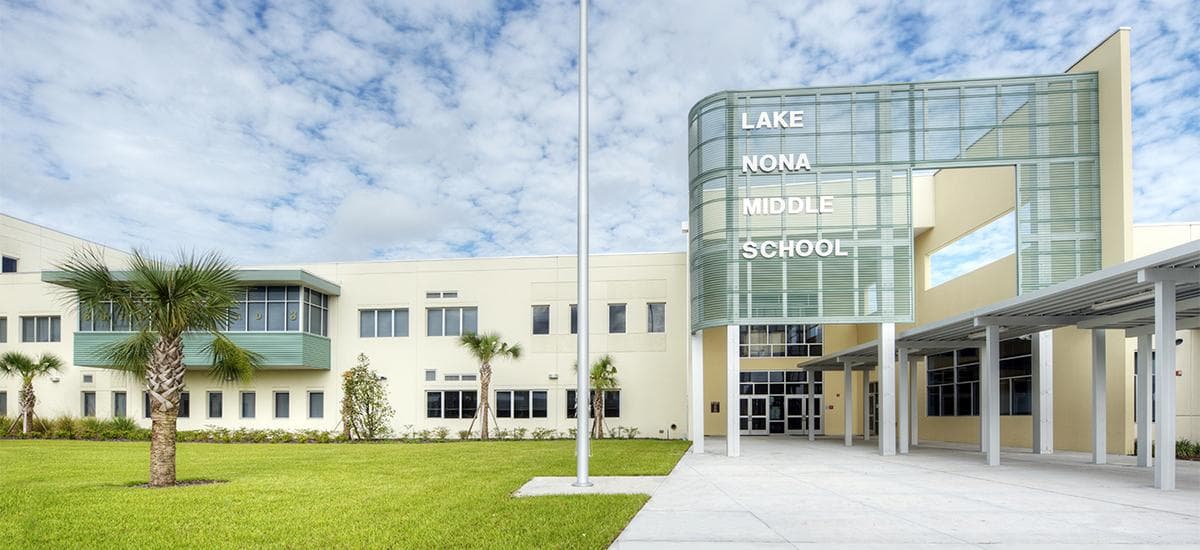
Education
Lake Nona Middle School
Orlando
Orlando, Florida
112,000 SF
Mechanical + Plumbing Engineering
Mechanical and plumbing engineering and project administration for a 112,000-square-foot middle school in Lake Nona, Orlando, Florida, including ice storage and hurricane-shelter ventilation.
View Project →
Education
Meadowlane Intermediate School
Central Energy Plant
West Melbourne, Florida
116,700 SF
Mechanical + Plumbing Engineering
Mechanical and plumbing engineering and project administration for a 116,700-square-foot school and water-cooled central energy plant in West Melbourne, Florida.
View Project →Common Questions
What temperature is chilled water?
Many commercial plants supply water around 42–45°F and see return water several degrees warmer. Exact temperatures are a design choice tied to coil performance and efficiency.
What is condenser water?
On water-cooled chillers, condenser water carries heat from the chiller to a cooling tower, where it is rejected to outdoor air.
Filed under Mechanical Engineering
Continue exploring
Related Questions
What Is a Chilled Water System?
A chilled water system uses a chiller to cool water that is pumped to air-handling units and other coils, then returned to the plant to be cooled again.
Air-Cooled vs. Water-Cooled Chillers
Air-cooled chillers reject heat to outdoor air at the unit; water-cooled chillers reject heat through condenser water and a cooling tower. Each fits different site and plant conditions.
When Are Chilled Water Systems Used?
Chilled water systems are typically used in larger commercial, education, institutional, and specialized facilities where centralized cooling capacity and flexible air-side design matter.
What Is Building Automation?
Building automation is the control system that starts, stops, sequences, and monitors HVAC and related equipment so a building operates as designed.
What Is HVAC Engineering?
HVAC engineering is the design of heating, ventilating, and air-conditioning systems that control temperature, humidity, ventilation, and indoor air quality.
What Is a Building Automation System?
A building automation system is the networked hardware and software that senses conditions, runs controllers, and operates HVAC equipment as a coordinated plant.
Related BEED Services
Service
Chilled Water Systems
Chiller plants, pumping, air-handling equipment, and controls for larger commercial and institutional facilities.
Service
Central Plant Engineering
Central heating and cooling plants, thermal distribution, and plant optimization for campuses and large buildings.
Service
Building Automation
Controls sequences, BAS architecture, and integration that make mechanical and electrical systems operate as designed.
Related Locations
Local Presence
BEED Engineering — Based in Palm Bay, Serving Florida
BEED Engineering is a Palm Bay-based MEP firm providing mechanical, electrical, and plumbing design for commercial and specialized facilities throughout Central Florida and Florida. BEED Engineering is a firm you can trust to get the job done.
Need Engineering Help?
Need help with a chiller plant that is not performing?
BEED Engineering evaluates chilled water plants, pumping, and controls for efficiency, capacity, and maintainability.